
Protecting Your Business Assets in the Age of AI
Security is now Architecture
AI isn’t just a productivity multiplier.
It’s a threat multiplier.
Over the past two years, the conversation around artificial intelligence has focused heavily on efficiency — automation, generative AI, workflow acceleration, intelligent analytics. But beneath that optimism is a structural shift in risk.
For business owners, CIOs, IT directors, and RevOps leaders, AI cybersecurity risks are no longer theoretical. The cost of inaction is rising — and traditional perimeter-based security models are not built for what’s coming next.
The core issue isn’t whether AI is dangerous.
It’s whether your architecture is prepared for it.
The New Threat Landscape: Faster, Cheaper, More Convincing
AI has lowered the barrier to entry for sophisticated cyber attacks.
Industry research consistently shows that phishing remains one of the most successful initial attack vectors in data breaches. Now combine that with generative AI capable of producing highly personalized, grammatically flawless messages at scale.
We’re also seeing:
AI-generated phishing campaigns tailored to specific executives
Deepfake voice impersonation targeting finance teams
Synthetic video fraud in procurement workflows
Prompt injection attacks against generative AI tools
Data leakage via ungoverned employee AI usage
Deepfake fraud alone has already resulted in high-profile financial losses across global enterprises. The technology required to simulate voice or likeness is no longer limited to advanced nation-state actors.
In short: AI compresses the attack cycle.
What used to require weeks of reconnaissance and manual effort can now be automated.
The Four Asset Categories at Risk
Most organizations think in terms of “network security.” In the age of AI, that framing is incomplete.
Your exposure is broader — and more behavioral.
1. Identity
AI-driven attacks increasingly target credentials, authentication flows, and executive impersonation. Identity is now the primary attack vector.
If access controls rely solely on passwords and static MFA, your risk profile is elevated.
2. Communication Channels
Unified communications platforms, collaboration tools, and contact center systems are prime surfaces for AI phishing and voice spoofing.
As businesses deploy secure cloud communications, they must account for voice cloning, SMS fraud, and AI-generated social engineering attempts.
3. Cloud Infrastructure
The move toward AI-native tools increases API exposure. Every integration is a potential vulnerability.
Misconfigured cloud storage, exposed APIs, and insufficient logging remain common breach sources — even before AI acceleration.
4. Customer and Operational Data
Generative AI systems require data. When employees paste proprietary information into public LLM tools without governance, data exfiltration becomes a real concern.
This is one of the fastest-growing but least monitored threat vectors today.
Security Must Become Architectural
Historically, security was layered onto infrastructure.
Today, security must be embedded into design decisions from the outset.
Three foundational principles define modern cloud security best practices in the AI era:
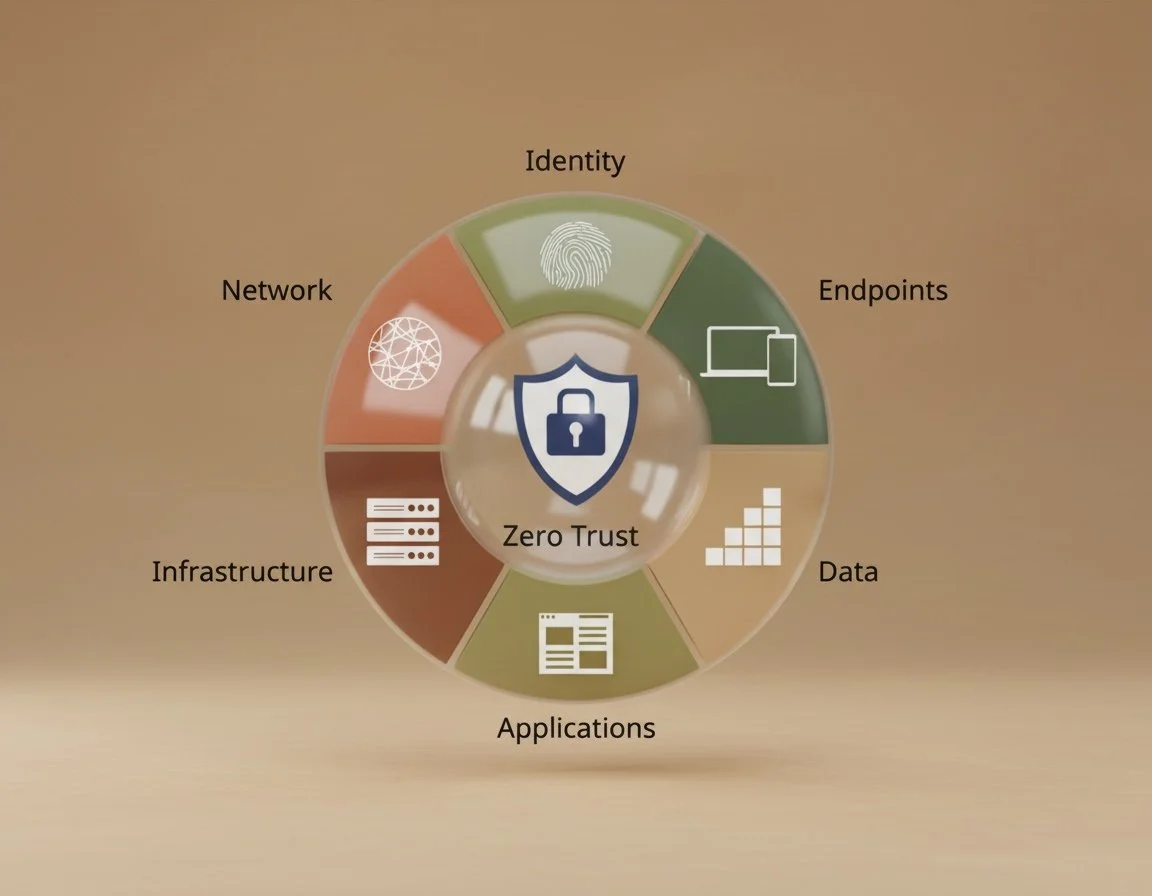
1. Zero Trust Architecture
Trust nothing. Verify everything.
Zero trust architecture assumes breach is possible and limits lateral movement through:
Continuous authentication
Context-aware access controls
Micro-segmentation
Strict identity verification
Zero trust isn’t a product — it’s a posture.
2. Least Privilege Access
AI amplifies the damage a compromised account can cause.
Access policies should:
Limit user permissions to only what’s required
Automatically revoke unused privileges
Monitor anomalous behavior patterns
Behavior-based analytics are increasingly critical here.
3. API Governance & Observability
AI-native environments rely heavily on APIs.
Strong governance includes:
Encrypted data in transit and at rest
API rate limiting
Logging and monitoring at the integration layer
Vendor security audits
Without observability, detection becomes reactive instead of preventative.
The Shadow AI Problem
One of the most under-discussed AI data protection risks is internal usage.
Employees are experimenting with generative tools daily.
The problem isn’t experimentation.
It’s unmanaged experimentation.
If your organization lacks:
Clear AI usage policies
Approved AI tool lists
Data handling guidelines
Training on prompt hygiene
You likely already have shadow AI operating within your company.
Blanket bans rarely work. Governance with enablement tends to produce better results.
Vendor Due Diligence Matters More Than Ever
As AI becomes embedded in UCaaS, CCaaS, CRM, ERP, and cloud infrastructure platforms, vendor selection is now a security decision — not just a feature decision.
When evaluating vendors, business leaders should ask:
Where is AI processing occurring (local vs. external models)?
Is customer data used for model training?
What encryption standards are enforced?
What certifications are maintained (SOC 2, ISO 27001, etc.)?
How is AI output monitored for compliance risks?
AI acceleration without governance increases regulatory exposure, especially in industries handling financial, healthcare, or personally identifiable information.
Neutral Reality: AI Is Not the Enemy
It’s important to remain balanced.
AI itself is not inherently more dangerous than prior technological shifts.
Email introduced phishing.
Cloud introduced misconfiguration risk.
Mobile introduced endpoint sprawl.
AI introduces speed and scale.
Organizations that treat AI as a productivity layer while ignoring its security implications create asymmetrical risk.
Organizations that embed AI governance into architecture create asymmetric advantage.
Strategic Questions for Leadership
If you’re responsible for technology oversight, ask:
Do we know where AI tools are being used internally?
Have we mapped AI exposure across identity, communications, infrastructure, and data?
Are our AI cybersecurity risk policies reactive or architectural?
Are we educating employees on AI-enabled fraud tactics?
Is our cloud environment designed for zero trust — or assumed trust?
These questions are no longer optional.
The Path Forward
Protecting business assets in the age of AI requires:
Identity-first security
Cloud-native monitoring
Strong vendor governance
Clear internal policy
Ongoing education
Security can’t be delegated solely to IT. It must be understood at the executive level.
AI increases both operational leverage and operational risk. The difference between the two outcomes is governance.
Final Thought
The businesses that thrive over the next five years won’t be the ones that adopt AI the fastest.
They’ll be the ones that adopt it responsibly — with architecture, policy, and oversight aligned.
If you’d like a practical checklist to assess your organization’s exposure across identity, communications, and cloud infrastructure, I share periodic frameworks and governance models in my newsletter.
No alarmism. No vendor bias. Just structured guidance for business leaders navigating a rapidly evolving environment.
If that would be helpful, feel free to subscribe or reach out.
